
Lantern Pharma Inc. a clinical-stage AI-driven precision oncology company, today announced the formal creation of Open-Medicine AI (OMAI) and the execution of commercial licensing agreements between OMAI and Lantern Pharma. The agreements, which have received Lantern Pharma Board approval, are consistent with the framework outlined in Lantern’s most recent registered direct financing and establish the commercial operating structure for the multi-agentic AI co-scientist platform previously launched as withZeta.ai.
OMAI will continue to advance the multi-agentic architecture, first proven in oncology and rare cancer research, while expanding its application across broader disease areas. The formation of the entity and the licensing arrangements position OMAI for independent growth, while expanding value creation opportunities and preserving strategic alignment with Lantern Pharma’s clinical programs and shareholders.
The creation of Open-Medicine AI and the execution of these licensing agreements mark a significant milestone,” said Panna Sharma, President and CEO of Lantern Pharma and Founder of Open-Medicine AI. “withZeta.ai demonstrated that a true multi-agentic co-scientist — specialized agents working in coordinated intelligence rather than a single model answering isolated questions — can dramatically compress research timelines and reduce the cost of generating hardened, actionable scientific insights. Open-Medicine AI takes that proven foundation and gives it the corporate structure, commercial licenses, and operational focus needed to scale across oncology and into additional complex disease areas.
In the first quarter of 2026, Lantern established and staffed an AI Center of Excellence in Bengaluru, India. This center will serve as a core operational hub accelerating the development, refinement, and scaling of the Open-Medicine platform. The Bengaluru team will bring additional specialized talent to the existing team in Dallas (where Lantern is also headquartered). Both sites will focus on functional enhancements in multi-agent systems, computational biology modeling, knowledge engineering, and large-scale scientific curation — furthering Open-Medicine’s ability to deliver production-grade capabilities to researchers and institutions worldwide.
The global market for AI-enabled drug discovery and development tools is projected to exceed $10 billion by 2030, with oncology representing the largest therapeutic segment and compound annual growth rates above 30 percent. The underlying need is structural: traditional drug development remains slow, expensive, and poorly suited to the hundreds of rare and complex diseases that lack commercial scale under conventional models. Knowledge remains fragmented across literature, clinical trial databases, institutional archives, and individual expertise, while experimental iteration continues to consume months or years and hundreds of thousands to millions of dollars per cycle.
At the same time, major general-purpose AI companies — including Anthropic and OpenAI — have publicly signaled or begun developing platforms and tools aimed at scientific discovery and drug development. Their entrance validates the long-term importance of AI co-scientists while also highlighting the differentiation required for durable impact. While general models excel at broad reasoning and language, domain-specific multi-agentic systems grounded in curated ontologies, domain-specific computational tools, and disease-area expertise are required to deliver the precision, auditability, and scientific rigor demanded by drug development.
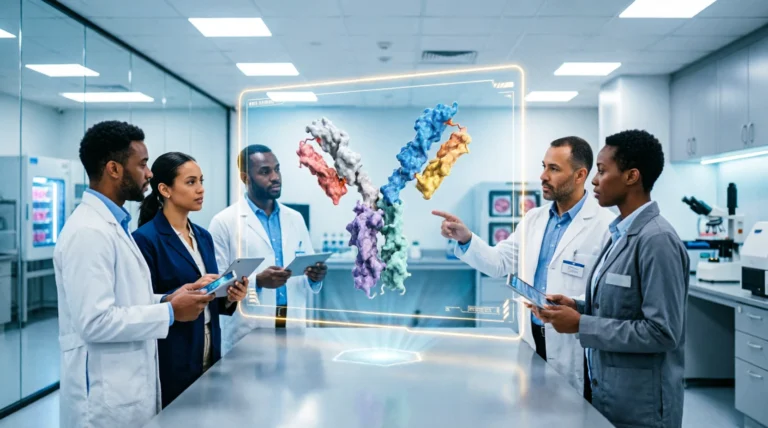
OMAI is uniquely positioned for differentiated value creation at this intersection. Built from the ground up for oncology and rare disease research and drug-development, the platform combines specialized agent roles, recursive investigation modes, living knowledge graphs, and production tools (including blood-brain barrier prediction, multi-omic analytics via ZetaOmics™, and generative chemistry capabilities). Its architecture is designed not merely to retrieve information but to generate, stress-test, and harden insights in a manner that mirrors how expert scientific teams actually work – iteratively, collaboratively and focused on actionable results.
The May 2026 financing of Lantern Pharma’s registered direct was led by Empery Asset Management, LP and also included an existing institutional healthcare investor and Lantern Board members. Mr. Ryan Lane, CIO and founder of Empery Asset Management stated, “At Empery, we continue to be impressed by the relevance and usefulness of the insights and results generated by withZeta.AI’s co-scientist platform. Among the various enterprise level agentic AI toolings we use, withZeta.AI continues to be our preferred platform for AI-assisted biopharma due diligence and research.”
OMAI inherits the full multi-agentic system originally commercialized as withZeta.ai, including:
While rare cancers remain a core component, OMAI’s roadmap includes systematic expansion into additional high-need disease areas – especially in collaboration with leading academic and commercial leaders – that experience the same challenges of fragmented knowledge, high failure costs, limited traditional investment and urgency of patient and disease management needs.
Open-Medicine AI is built to change how medicines are discovered and developed globally, and as a separate company, to pursue dedicated funding and a valuation path distinct from Lantern’s clinical activity and operations.” – Panna Sharma, CEO & President of Lantern Pharma
Lantern Pharma Inc. is a clinical-stage precision oncology company leveraging artificial intelligence and machine learning to transform cancer therapy development. The Company’s pipeline includes LP-184, LP-284, and LP-300. Lantern established an AI Center of Excellence in Bengaluru, India, in the first quarter of 2026 and has commercialized its multi-agentic AI capabilities through the platform now operating as Open-Medicine AI (OMAI).
Open-Medicine AI builds multi-agentic systems that do the work of a research team — generating novel insights, interrogating literature and data, and pressure-testing conclusions until they hold, all with transparent, auditable reasoning. The platform was built inside active drug development at Lantern Pharma, where its output and insights had to survive contact with real programs, real regulators, and real patients. Most discovery AI has never been held to that standard. Open-Medicine AI is planned to operate beyond rare cancers, across oncology and into other diseases where the science is hard and the answers are overdue.
Source link: https://www.businesswire.com/