
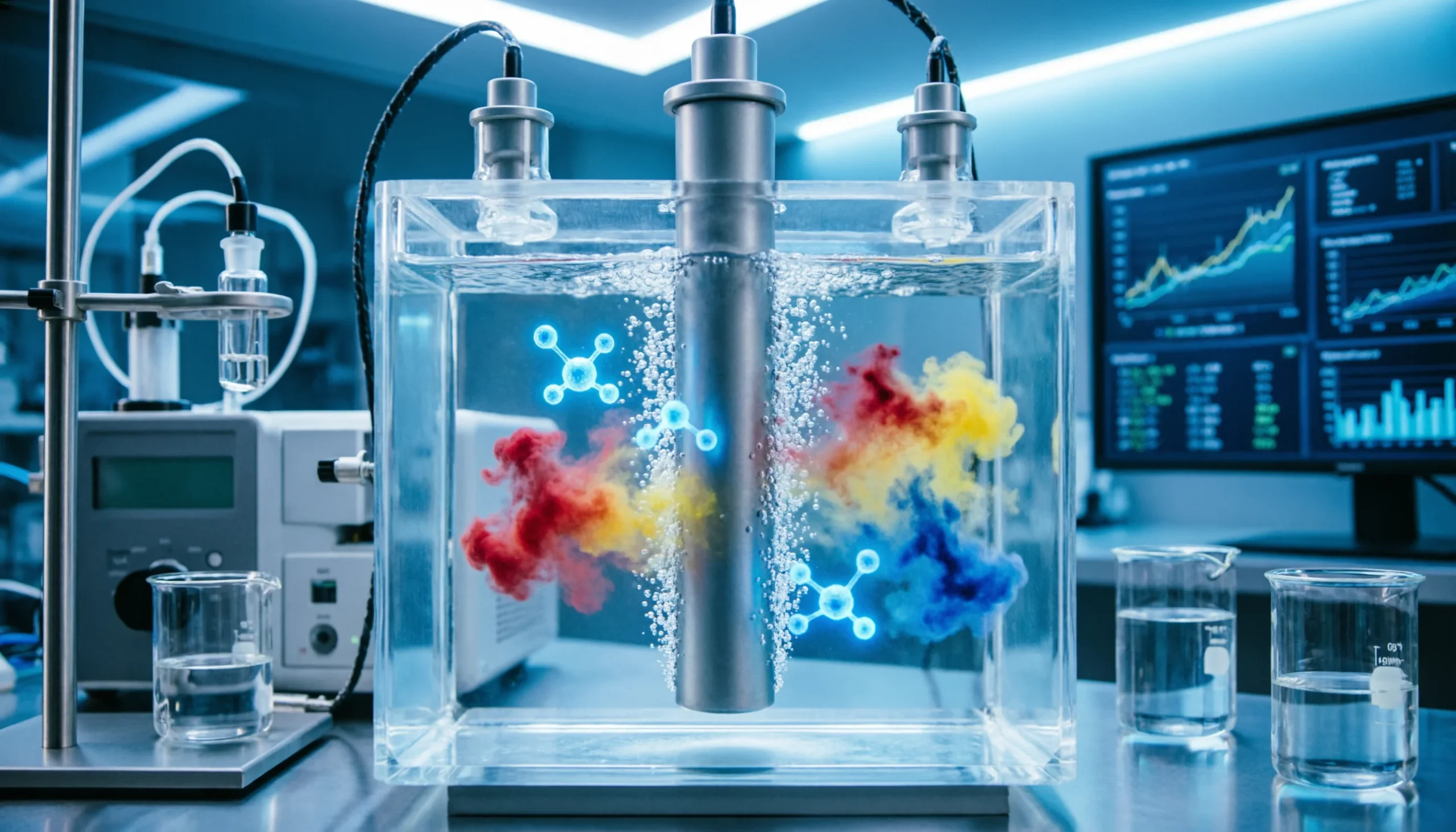
Researchers at Argonne National Laboratory analyze reactive molecules generated during electrocatalysis to better understand how electricity-driven processes can break down persistent water pollutants
Modern society relies on thousands of synthetic chemicals that improve everyday life, from vibrant textile dyes to agricultural pesticides and pharmaceutical compounds. However, many of these substances eventually find their way into rivers, lakes, and groundwater systems, creating serious environmental and public health concerns. Among these pollutants are compounds such as Bisphenol A, antibiotics, pesticides, and other industrial chemicals that are difficult to remove through conventional water treatment methods. Because these contaminants are highly stable and persistent, they can remain in water systems for long periods of time, posing risks to ecosystems and human health.
Traditional water treatment techniques, including filtration, sedimentation, and biological treatment, are effective for removing many common pollutants. However, they often struggle to eliminate complex chemical compounds that dissolve easily in water and resist natural degradation. As a result, scientists and engineers have been exploring advanced treatment technologies that can break down these stubborn pollutants into harmless components.
One promising approach involves the use of electricity to drive chemical reactions directly within water. This process is known as Electrocatalysis, a technique that uses electrical energy to trigger reactions on the surface of specially designed electrodes. In many ways, the process resembles the electrochemical reactions that occur inside a battery. Electrodes act as the key components that send and receive electrical current, enabling chemical reactions that would otherwise be difficult or impossible to achieve under normal conditions.
When electricity flows through water in an electrocatalytic system, it can generate a group of highly reactive molecules known as Reactive Oxygen Species. These molecules contain oxygen and are extremely powerful oxidants capable of breaking apart complex chemical pollutants. Among the most important members of this group are Ozone and Hydrogen Peroxide. Both of these substances are widely known for their ability to destroy contaminants by oxidizing them, effectively converting harmful molecules into simpler and less dangerous forms.
Reactive oxygen species are particularly valuable in water purification because they can attack and degrade a wide variety of persistent pollutants. These include industrial dyes, pharmaceutical residues, and endocrine-disrupting chemicals like Bisphenol A. Through oxidation reactions, these reactive molecules break the chemical bonds within pollutants, transforming them into smaller compounds that are easier to remove or that pose far fewer risks to the environment.
Despite their tremendous potential, reactive oxygen species present a major challenge for scientists studying water treatment technologies. The difficulty arises from the fact that these molecules are extremely unstable. They exist only briefly before decomposing or reacting with other substances in the surrounding water. In addition, they are typically produced in very small concentrations, often measured in parts per billion. This makes them incredibly difficult to detect, measure, and analyze using conventional chemical detection methods.
Understanding which specific reactive oxygen species are produced during electrocatalysis is crucial for optimizing water purification systems. Different oxidants have different strengths and reaction pathways, meaning that some may be more effective than others for breaking down particular pollutants. Without accurate measurement techniques, researchers have struggled to fully understand how electrocatalytic systems operate and how they can be improved.
To address this challenge, researchers at Argonne National Laboratory, part of the U.S. Department of Energy, have developed a new method for detecting and quantifying reactive oxygen species with unprecedented sensitivity. Their work, recently published in ACS Catalysis, introduces a technique that allows scientists to measure these short-lived molecules in real time.
The study was led by electrochemist Pietro Papa Lopes, who emphasized the importance of accurately identifying these oxidants. According to Lopes, reactive oxygen species are difficult to observe because they disappear quickly and often coexist with other similar molecules. However, knowing exactly which oxidants are present and how much of each is produced is essential for designing more efficient and effective water treatment technologies.
The research team developed an innovative experimental setup involving two electrodes arranged in a specialized configuration. The first electrode, known as a disk electrode, is where the primary electrochemical reaction takes place. When electricity passes through the system, water molecules at this disk electrode undergo oxidation reactions, generating various reactive oxygen species.
Surrounding this disk electrode is a second electrode shaped like a ring. This concentric ring electrode serves as a highly sensitive detector. As reactive oxygen species form at the disk electrode and diffuse outward, they encounter the ring electrode, which generates an electrical signal in response to their presence. By analyzing these signals, the researchers can identify which oxidants are present and measure their concentrations with remarkable precision.
This two-electrode approach provides a powerful tool for studying electrochemical reactions in water treatment systems. Not only does it reveal how much of each reactive oxygen species is produced, but it also shows how different operating conditions influence their formation. For example, changes in voltage, electrode materials, or water chemistry can alter which oxidants are generated and how efficiently they degrade pollutants.
The ability to measure reactive oxygen species in real time represents a significant advancement for the field of electrochemical water purification. With this new method, scientists can better understand the fundamental processes occurring at electrode surfaces and design systems that maximize the production of the most effective oxidants.
Beyond water purification, the findings from this research have important implications for other emerging energy technologies. Electrochemical reactions involving oxygen species also play a central role in devices such as Fuel Cells and Electrolyzers. Fuel cells convert hydrogen or other chemical fuels into electricity through controlled electrochemical reactions, while electrolyzers use electricity to split water molecules into hydrogen and oxygen.
These technologies are key components of the global transition toward cleaner energy systems. For example, hydrogen produced by electrolyzers can serve as a low-carbon fuel for transportation, industrial processes, and energy storage. Some advanced electrochemical systems can even convert carbon dioxide into synthetic fuels suitable for aviation.
Because reactive oxygen species often appear as intermediate products in these electrochemical reactions, the new detection technique developed at Argonne could help improve the efficiency and performance of these energy technologies as well. By providing detailed insights into how oxygen-related reactions occur at electrode surfaces, the method allows researchers to refine catalysts, optimize reaction conditions, and develop more efficient devices.
Ultimately, the work from Argonne National Laboratory establishes a new benchmark for researchers studying electrochemical systems. By providing a reliable and highly sensitive method for detecting and quantifying reactive oxygen species, the study enables scientists to compare experimental results more accurately and design better technologies for water purification and clean energy production.
As global demand for clean water continues to grow and environmental pollution becomes an increasingly urgent challenge, innovations like this will play a crucial role in protecting natural resources and ensuring sustainable water supplies for future generations. Through continued research in electrocatalysis and advanced electrochemical methods, scientists are moving closer to developing powerful new tools capable of removing even the most persistent pollutants from the world’s water systems.