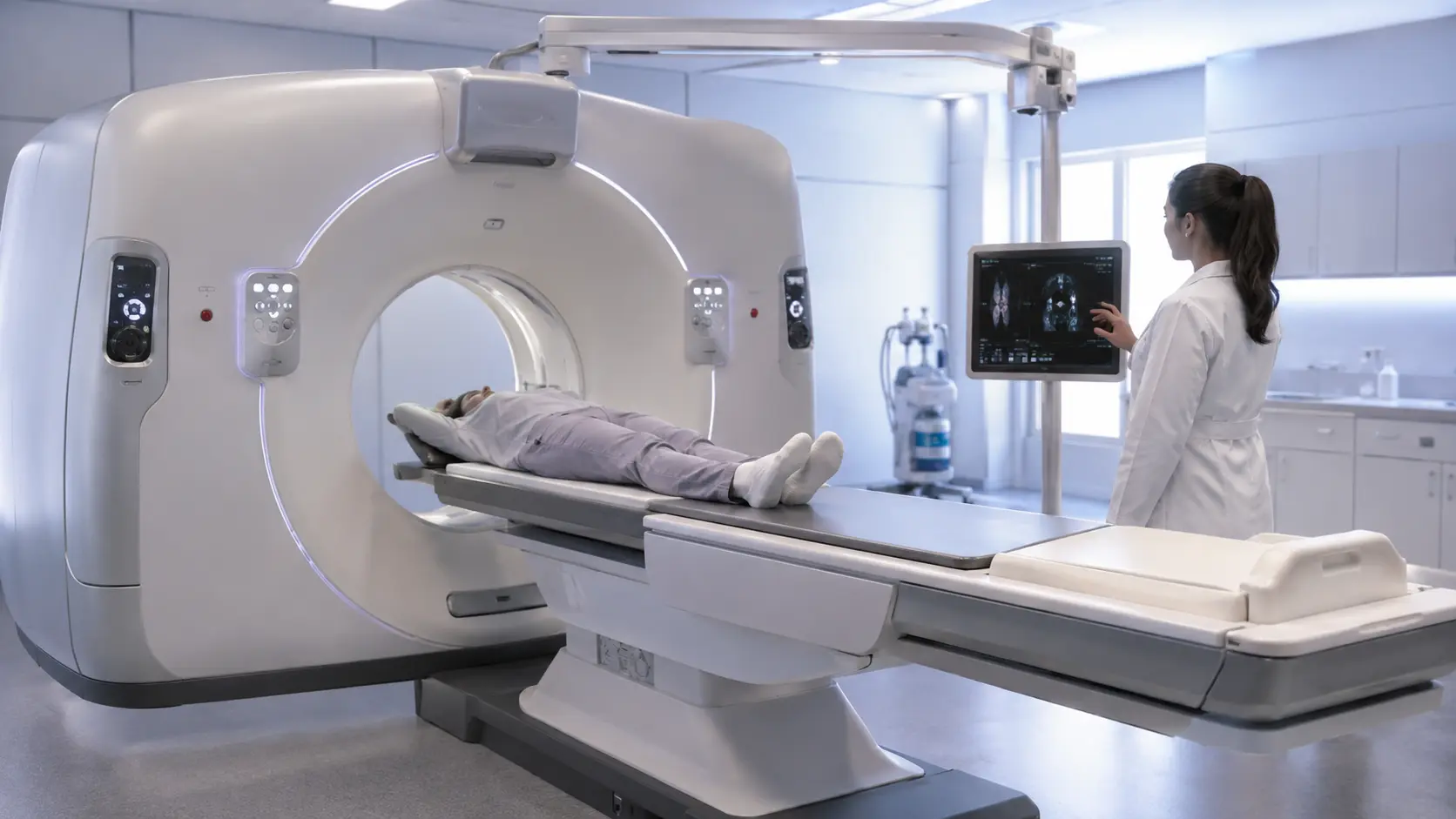
As theranostics adoption acceleratesi and radiopharmaceutical demand grows,ii healthcare systems are under increasing pressure to scale nuclear medicine operations while improving diagnostic confidence and workflow efficiency. At the 2026 Society of Nuclear Medicine and Molecular Imaging (SNMMI) Annual Meeting, GE HealthCare showcases its latest technologies and AI-enabled workflows to help support precision care across care pathways.
Nuclear medicine is undergoing rapid expansion as healthcare systems increase adoption of theranostics, broaden radiopharmaceutical access and invest in precision diagnostics and targeted therapies. This momentum is also evident in global nuclear medicine market projections, which anticipate growth from approximately $7.8 billion in 2024 to more than $30.7 billion by 2034.iii
Nuclear medicine is moving from early innovation to large-scale clinical implementation, shares Jean-Luc Procaccini, President and CEO, Molecular Imaging and Computed Tomography (MICT), GE HealthCare. “Healthcare systems need technologies and workflows that help expand access, improve efficiency and support more confident clinical decision-making as theranostics adoption and precision care evolve.
Turning convergence into clinical reality
Growing demand for precision diagnostics and targeted therapies is helping accelerate the evolution of nuclear medicine. Advances in radiopharmaceuticals and imaging technologies help clinicians diagnose disease, improve treatment planning and expand access to personalized care. As adoption increases, healthcare systems are also facing new operational challenges – including how to scale infrastructure, streamline workflows and expand patient access beyond traditional hospital settings.iv
Rising prevalence of chronic diseases is further driving demand for timely and advanced diagnoses and targeted treatment approaches. Fortunately, new care delivery models are already taking shape across care pathways. These models are increasingly enabled by advances in radiopharmaceuticals that expand access to PET imaging and support more scalable, routine clinical use across care settings.
Early examples of this shift are emerging to reach patients beyond traditional hospital environments:
This is an exciting moment for nuclear medicine because we are moving beyond simply detecting disease to truly understanding its biology and behavior,” says Dr. Munir Ghesani, MD, FACNM, FACR, FSNMMI, Chief Medical Officer at United Theranostics and System Chief of Nuclear Medicine at the Mount Sinai Health System in New York. “Technologies that combine advanced imaging, quantitative analysis and innovative radiopharmaceuticals are helping clinicians make more informed decisions earlier in the care pathway – ultimately improving how we diagnose, treat and monitor patients.
GE HealthCare’s nuclear medicine portfolio spans imaging systems, AI-enabled software and pharmaceutical diagnostics designed to help clinicians support the full patient journey — from detection and diagnosis through therapy planning and monitoring.
Translating rapid innovation into real-world clinical impact
At SNMMI 2026, GE HealthCare is highlighting key technologies and software designed to help healthcare systems scale precision imaging, theranostics and quantitative analysis across clinical and research settings:
Advanced imaging technologies –
Radiopharmaceuticals and imaging agents –
Together, these imaging technologies and agents are designed to support more scalable, data-driven and personalized nuclear medicine workflows across care pathways.
About GE HealthCare Technologies Inc.
GE HealthCare is a leading global healthcare solutions provider of advanced medical technology, pharmaceutical diagnostics, and AI, cloud and software solutions that help clinicians tackle the world’s most complex diseases. Serving patients and providers for 130 years, GE HealthCare is delivering bold innovations designed for the next era of medicine across its Advanced Imaging Solutions, Patient Care Solutions, and Pharmaceutical Diagnostics segments to help clinicians deliver more personalized, precise patient care. We are a $20.6 billion business with approximately 54,000 colleagues working to create a world where healthcare has no limits.
Source link: https://www.businesswire.com/